Cloud PBX Versus Premises PBX for Business
Compare cloud PBX versus premises PBX for cost, security, control, reliability, and growth to select the right communications model for your business.
A customer calls during a service outage, a remote employee needs to take calls from home, and your IT team must apply a security policy across every site. These are not separate communications problems. They are the practical test of cloud PBX versus premises PBX - and of whether your phone system supports the way your business actually operates.
The right answer is rarely based on one feature or a simple preference for cloud or hardware. It depends on your regulatory requirements, internal IT capacity, network design, uptime objectives, contact center needs, and appetite for capital expense. For many organizations, the strongest architecture may even combine both models.
Cloud PBX Versus Premises PBX: The Core Difference
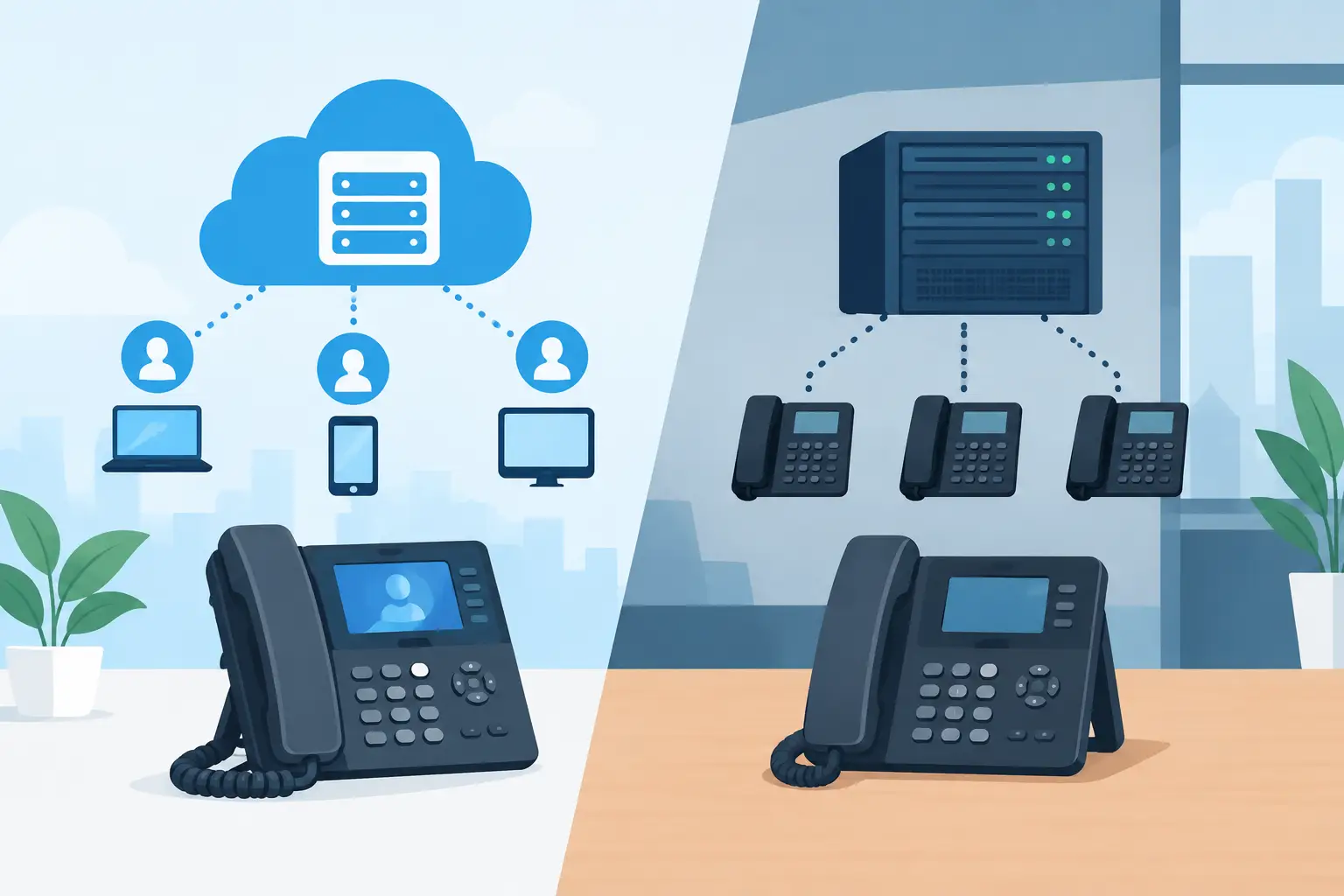
A cloud PBX is business phone system software hosted in a provider-managed cloud environment. Users connect through desk phones, softphones, mobile apps, or browsers over an internet connection. The provider operates the core infrastructure, delivers software updates, and generally manages high-availability architecture across multiple data centers or cloud regions.
A premises PBX, often called an on-premises PBX, runs on hardware and software located in your office, data center, or private facility. Your organization owns or controls the underlying infrastructure, along with the operating environment, upgrade timing, and much of the security model. A self-hosted PBX can also run in a private cloud or colocation environment while retaining the control associated with a premises deployment.
That distinction affects much more than where a call server sits. It determines who carries responsibility for maintenance, how quickly you can expand capacity, how outages are handled, and how easily voice can connect with CRM, contact center, and customer experience systems.
Cost: Capital Investment or Operating Flexibility
Premises PBX traditionally requires a larger up-front investment. Hardware, licensing, implementation services, redundancy components, carrier connections, and ongoing support can create a substantial capital expense. This approach may be financially sound for organizations with stable user counts, existing data center capacity, and a long equipment refresh cycle.
Cloud PBX usually shifts spending toward a recurring operating model. Organizations pay for users, features, calling capacity, or usage, which can make budgeting more predictable and reduce initial deployment costs. It also prevents businesses from buying capacity years ahead of actual demand.
The comparison should not stop at monthly license pricing. Total cost of ownership includes network upgrades, SBCs, carrier contracts, IT labor, security operations, power and cooling, hardware replacement, disaster recovery, and the cost of delayed upgrades. A lower subscription price does not automatically make cloud the lower-cost choice, and owned hardware is not automatically cheaper after support and operational overhead are included.
For a fast-growing contact center, cloud capacity can reduce the cost and delay of expansion. For a large organization with specialized infrastructure and predictable demand, a premises model can provide a more controlled long-term cost profile.
Control, Security, and Compliance
Premises PBX gives technical teams direct control over data paths, configuration standards, versioning, and physical infrastructure. That can be essential when voice recordings, customer data, or call routing must remain within a specific facility or jurisdiction. It also supports organizations that require tightly segmented networks or cannot depend on public internet access for critical communications.
That control brings operational responsibility. Your team must maintain patching schedules, monitor performance, secure administrative access, test failover, and plan for hardware lifecycle events. A premises platform is only as resilient as the architecture and discipline supporting it.
Cloud PBX providers can offer enterprise-grade controls, including encryption, role-based access, identity integration, audit logs, geographic redundancy, and automated updates. For many businesses, a cloud-native service improves their security posture because specialized teams continuously manage the platform and its underlying infrastructure.
However, regulated organizations should validate more than a provider's general security claims. Review data residency options, recording retention policies, encryption practices, incident response procedures, access controls, and compliance requirements specific to your industry. The question is not whether cloud is secure. The question is whether the provider's security and governance model meets your exact obligations.
Reliability Depends on Architecture, Not Location Alone
A common assumption is that a premises PBX is more reliable because it remains local during an internet outage. Another assumption is that cloud PBX is more reliable because it runs across geographically distributed infrastructure. Both can be true, depending on design.
A premises system may keep internal calling available during a WAN failure, but external calling can still depend on carrier connectivity. It also needs redundant power, hardware failover, alternative routing, and a tested disaster recovery environment. A single appliance in a server closet is not enterprise resilience.
Cloud PBX can provide geographic redundancy and rapid rerouting to mobile devices or alternate sites. But it relies on reliable connectivity at each business location. Organizations with high call volumes should design for dual internet connections, SD-WAN or intelligent traffic management, QoS policies, and cellular failover for priority users.
For customer-facing operations, the strongest reliability strategy often includes business continuity rules that automatically redirect calls when a location, queue, carrier, or endpoint becomes unavailable. Customers should reach a qualified person or a clear self-service path, not a dead line.
Scalability and Remote Operations
Cloud PBX has a clear advantage when teams change quickly. Adding users, opening a new site, enabling remote employees, or supporting seasonal agents can often be completed through centralized administration rather than hardware procurement and onsite installation. That speed matters when communications capacity is tied directly to revenue, customer response times, or service-level commitments.
Premises PBX can scale effectively, but growth is more deliberate. Capacity planning must account for licenses, ports, compute resources, network design, and physical redundancy. For organizations with a stable campus environment, that planning can be entirely appropriate. For distributed teams or businesses that frequently acquire locations, it can become a constraint.
Remote work also changes the evaluation. A cloud platform gives employees a consistent business identity across desk phones, desktop apps, mobile devices, and web clients. Presence, messaging, conferencing, call transfer, and voicemail can follow the user rather than the office extension. A modern premises PBX can support these capabilities too, but it may require VPN access, additional edge infrastructure, or more complex administration.
Customer Experience and Integration Requirements
A PBX is no longer just a dial tone platform. Sales teams need CRM click-to-call and call logging. Service teams need skills-based routing, recording, quality management, analytics, and AI-powered IVR. Customers expect a conversation to continue across voice, chat, email, and social messaging without repeating information.
Cloud platforms are often designed to connect these capabilities through APIs and prebuilt integrations. This makes cloud attractive for businesses consolidating UCaaS, contact center, and customer experience operations. Updates can introduce new automation and analytics features without a major infrastructure project.
A premises deployment may be the better fit when integrations must remain inside a private environment, when legacy applications cannot move to the cloud, or when highly customized call flows are central to operations. The trade-off is that each integration can increase the burden on internal development, testing, and upgrade management.
RingQ supports cloud, on-premises, self-hosted, single-tenant, and multi-tenant deployment options because enterprise communications requirements are rarely one-size-fits-all. The priority is to align the platform with the operating model, not force the operating model to fit the platform.
When Each Model Makes Sense
Cloud PBX is usually the stronger choice when your organization needs rapid deployment, distributed workforce support, elastic capacity, frequent feature updates, or integrated contact center capabilities. It is particularly effective for businesses that want IT teams focused on strategic systems rather than PBX infrastructure maintenance.
Premises PBX is often justified when you require strict infrastructure control, have specialized compliance or data residency requirements, operate in locations with unreliable internet access, or maintain a mature internal team capable of managing voice infrastructure. It can also be the practical path when a major legacy environment must remain local.
A hybrid approach deserves serious consideration when requirements differ by site, business unit, or workload. For example, a central facility may retain private call control while remote offices and mobile employees use cloud services. A company may also keep sensitive workloads in a dedicated environment while moving collaboration and customer engagement tools to the cloud.
Questions to Ask Before You Decide
Before selecting a deployment model, assess the operational requirements that will still matter three years from now. Consider these four questions:
- Can your network maintain voice quality and failover during provider or site outages?
- Who will own security patching, monitoring, upgrades, and disaster recovery testing?
- Which customer experience tools must integrate with telephony, and where can their data reside?
- How quickly must you add users, locations, channels, and contact center capacity?
The answers should be documented across IT, operations, security, finance, and customer experience leadership. A PBX decision made only on telecom pricing often creates costs elsewhere - in agent productivity, outage exposure, integration complexity, or customer frustration.
Choose the architecture that gives your organization the control it truly needs and removes the operational burden it does not. The best communications environment is the one that keeps teams productive, protects critical data, and ensures every customer interaction can move forward when conditions are less than perfect.
See RingQ in action
Talk to our team and find the right cloud PBX and contact center setup for your business.
Book a demo