
Beyond Cost Savings: How RingQ CCaaS Drives ROI and Business Growth
Consolidate your communications stack, optimize technology spending, and turn customer interactions into opportunities for revenue growth.

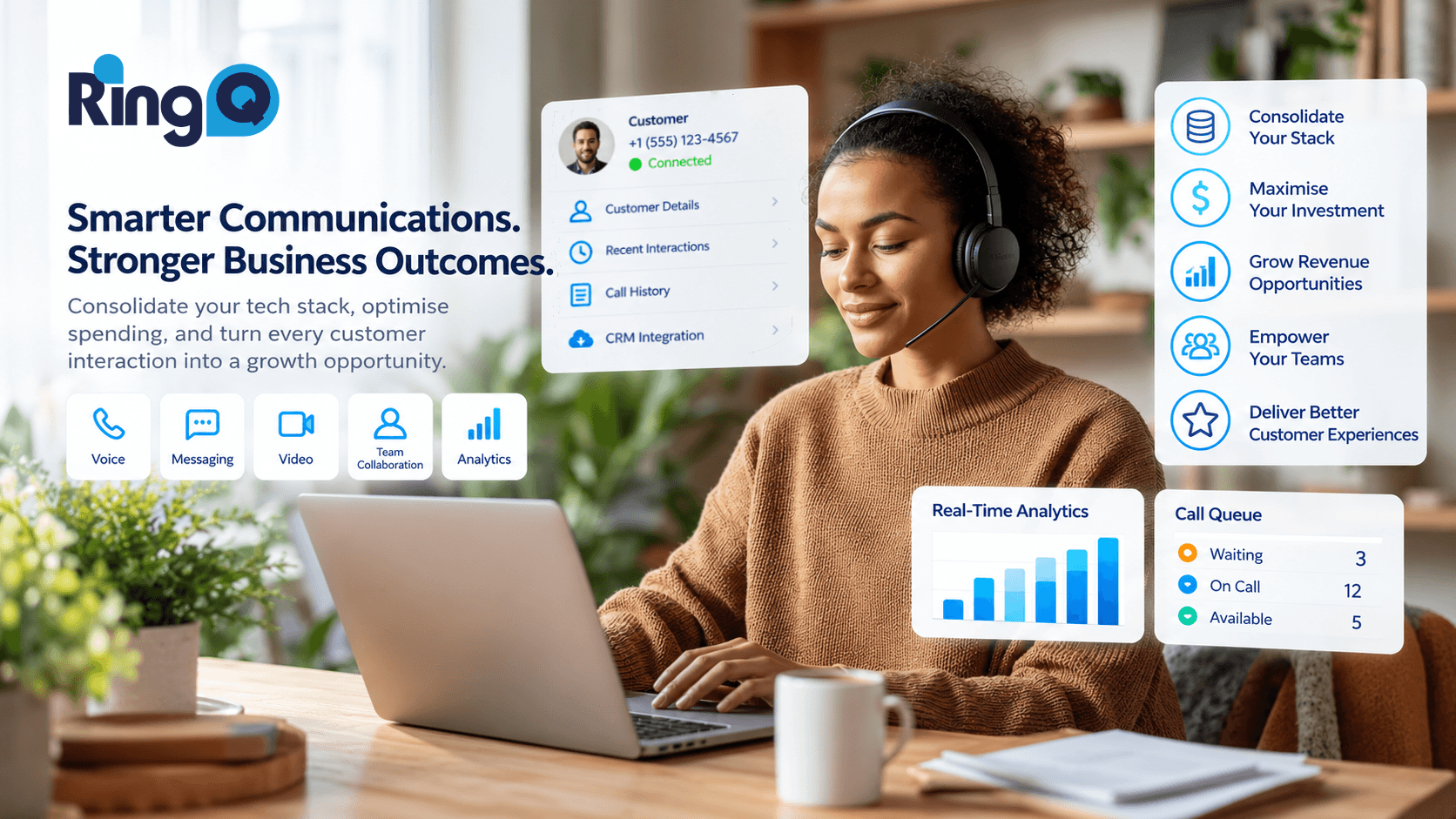
Customer communications are no longer just an operational necessity. They influence customer satisfaction, employee productivity, sales performance, and profitability. Yet many organizations still rely on separate systems for business telephony, contact center operations, messaging, and customer relationship management (CRM).
Managing these disconnected tools can increase costs, create administrative complexity, and make it harder to deliver a consistent customer experience.
RingQ Cloud CX offers an opportunity to rethink this approach by bringing cloud telephony and contact center capabilities together on a unified platform. The result is a communications strategy focused not only on controlling costs, but also on creating measurable business value.
1. Rethinking ROI: Look Beyond the License Fee
A meaningful return on investment (ROI) assessment considers the total cost of communications alongside the value those systems deliver.
Traditional contact center infrastructure can involve hardware, maintenance, upgrades, IT support, and multiple software subscriptions. A cloud-based Contact Center as a Service (CCaaS) model can help reduce infrastructure requirements and simplify ongoing management.
RingQ provides cloud contact center capabilities designed to support customer interactions, call routing, reporting, and integrations with business systems.
Potential benefits include:
- Reducing duplicated technology and support costs.
- Improving agent productivity through connected customer information.
- Streamlining call handling and follow-up.
- Improving visibility into call volumes and service performance.
- Scaling communications capacity as business needs change.
Actual savings depend on existing infrastructure, usage, implementation costs, and operational processes. The objective is to evaluate the complete business case rather than compare monthly license fees alone.
2. Consolidating the Technology Stack
One of the most compelling opportunities is technology-stack consolidation.
Organizations often operate separate platforms for business telephony, contact center queues, digital messaging, and customer interaction records. Although each system may serve a purpose, maintaining multiple platforms can create duplicated costs and disconnected workflows.
RingQ Cloud CX brings together capabilities including:
- Cloud PBX and business telephony.
- Inbound and outbound contact center operations.
- IVR, call queues, and advanced routing.
- Voice and digital messaging.
- Real-time monitoring, scheduled reporting, and customizable wallboards.
- CRM integrations, including caller information pop-ups and call logging.
- Desktop (Windows & Mac), mobile(iOS & Android), and browser-based access.
RingQ also supports digital messaging channels such as WhatsApp, SMS, Facebook Messenger, Telegram, LINE, and live website chat.
Consolidation can help reduce unnecessary overlap between systems, simplify administration, and give employees a more connected view of customer interactions. Existing specialist systems, such as CRM or property management platforms, can remain in place where they provide essential business functionality.
The strategic advantage: Fewer disconnected communications tools can mean less complexity, better visibility, and more opportunities to improve customer-facing processes.
Explore RingQ Cloud CX and its CCaaS capabilities.
3. Concurrent-Call Licensing: More Value From Every Extension
Licensing is a critical consideration for organizations with large numbers of users.
In a traditional per-user model, costs can increase with every additional licensed seat, even when many users rarely make calls or do not use the system simultaneously.
RingQ uses a concurrent-call licensing model, in which licensing is based on the number of simultaneous calls rather than the total number of users.
This distinction can be particularly valuable for organizations that need many extensions but have a lower number of concurrent calls.
For example, a business may require hundreds or thousands of extensions across departments, buildings, or locations without needing the same number of simultaneous external calls. Under a concurrent-call model, the organization can size its licensed capacity around actual calling requirements rather than simply its total extension count.
Potential advantages include:
- Cost efficiency: Avoid tying licensing directly to every individual extension.
- Scalability: Support large user populations across multiple locations.
- Operational flexibility: Accommodate part-time staff, shift patterns, and varying calling needs.
- More informed budgeting: Align capacity planning with expected simultaneous usage.
Concurrent-call licensing does not mean unlimited simultaneous calls. Organizations still need sufficient capacity for peak demand, and their business case should include implementation, connectivity, and any applicable telephony charges.
For organizations with many extensions and comparatively modest concurrent usage, this model can offer excellent value for money.
4. Hotels and Schools: Where the Licensing Model Can Deliver Strong Value
Hotels illustrate the potential particularly well. A property may need extensions for guest rooms, reception, reservations, housekeeping, maintenance, security, food and beverage, and management. The number of extensions can be substantial, even when relatively few internal or external calls occur simultaneously.
Concurrent-call licensing gives hotels an opportunity to support this broad extension estate without automatically licensing every extension as a separate concurrent-call seat.
RingQ's contact center capabilities can also help hotels manage reservation inquiries, route calls to the appropriate departments, and monitor call activity. Better handling of prospective guest inquiries can support booking opportunities, although any improvement in conversion rates should be measured rather than assumed.
Schools, colleges, and universities face a similar challenge. Extensions may be required across administration, admissions, student services, faculty, facilities, security, and multiple campuses.
A concurrent-call model can help these institutions align licensing with actual calling patterns while maintaining the communications access their teams need.
Call routing, queues, and reporting can also support admissions inquiries, administrative service, and coordination between departments.
Other potential beneficiaries include healthcare facilities, multi-site businesses, public-sector organizations, and companies with large distributed workforces. The suitability and savings depend on each organization's call patterns and capacity requirements.
So, are you ready to transform your communications into a competitive advantage? RingQ Cloud CX brings together the capabilities your business needs to simplify its technology stack, optimize communications spending, and turn customer interactions into opportunities for growth. It’s time to unlock the full business potential of every customer interaction with RingQ.