AI IVR Versus Phone Trees for Your Business
Compare AI IVR versus phone trees to improve call routing, reduce customer effort, and choose the right automation for your contact center operations.
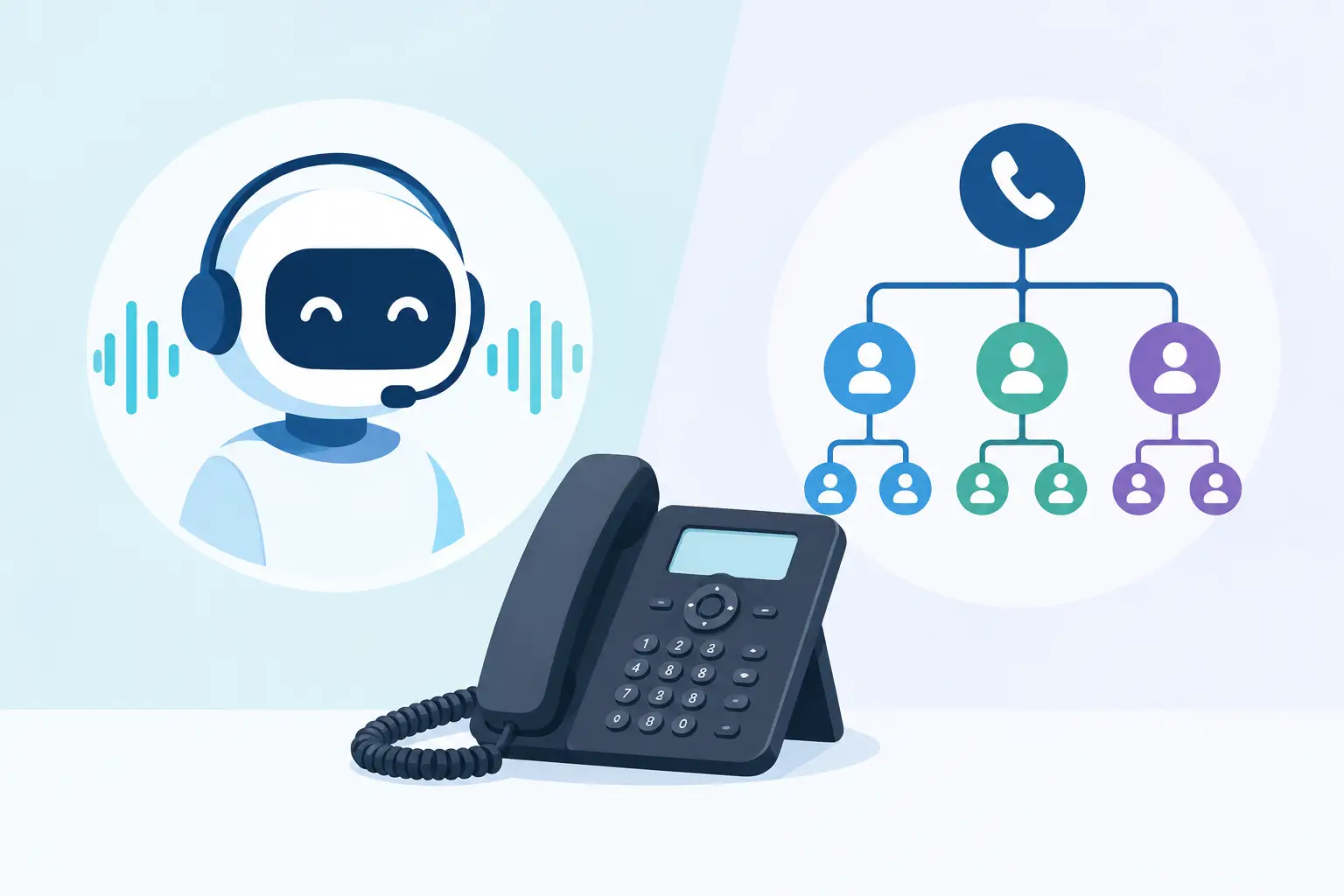
A customer calling to reset a password should not need to listen to six menu options before reaching help. Yet that remains the experience many businesses deliver through traditional phone trees. The decision between AI IVR versus phone trees is not simply about replacing old technology. It is about choosing the level of automation, control, and customer intelligence your call flows require.
For IT and contact center leaders, the right answer depends on call volume, request complexity, regulatory requirements, integration needs, and the cost of getting a customer to the right outcome. A basic menu still has a role. But when callers expect fast, natural interactions across voice and digital channels, a static routing structure can become an operational constraint.
AI IVR Versus Phone Trees: The Operational Difference
A phone tree is a rules-based call-routing system. The caller hears a prerecorded menu and responds through keypad selections or, in some cases, limited voice commands: “Press 1 for sales. Press 2 for billing.” Each response sends the call down a predefined branch.
Its strengths are predictability and simplicity. Administrators can define exactly where calls go, maintain a clear approval process for menu changes, and support high-volume routing without agent involvement. For a small set of stable, well-defined call reasons, that may be all a business needs.
An AI IVR uses speech recognition, natural language understanding, and business data to identify what a caller wants without forcing them through a fixed sequence of options. Instead of selecting from a menu, a caller can say, “I need to check the status of my replacement order,” or “My card was charged twice.” The system identifies the intent, retrieves available context, and either completes the request or routes the call with relevant information.
The distinction matters because a phone tree organizes calls around the company’s internal departments. AI IVR can organize the interaction around the customer’s stated need. That reduces unnecessary transfers and gives agents a more informed starting point when human support is required.
Where Traditional Phone Trees Still Make Sense
Phone trees are not obsolete. They are often the practical choice for straightforward routing, especially when the call flow has a narrow purpose. An after-hours line that directs callers to emergency support, office locations, or a voicemail box does not necessarily need conversational AI.
They also fit organizations that require highly controlled language and minimal system integration. A utility alert line, a simple departmental directory, or a small professional services firm with consistent call patterns can benefit from a menu that is easy to audit and inexpensive to maintain.
The trade-off appears when the menu grows. Every new department, product, region, language, or exception adds another branch. Over time, customers hear long prompts, choose the closest available option, and arrive at the wrong queue. Agents then spend time requalifying calls that should have been routed correctly from the start.
A phone tree can be dependable, but it cannot interpret ambiguity. If a caller says “cancel,” the system may not know whether that means cancel an order, an appointment, a subscription, or a service request. It only understands the options it was explicitly designed to offer.
What AI IVR Changes in the Customer Journey
AI IVR is most valuable when callers use varied language to describe a broad range of needs. It can recognize intent across different phrasing, ask a targeted follow-up question when needed, and use integrated customer data to personalize the next step.
For example, a caller may authenticate by phone number and date of birth, ask why a shipment is delayed, and receive an order-specific response drawn from the CRM or order management system. If the issue requires an agent, the AI IVR can pass the reason for the call, authentication status, order details, and interaction transcript to the correct team. The customer does not need to repeat the entire story.
This capability supports more than convenience. It can improve first-contact resolution, reduce average handling time, and protect agent capacity for work that needs judgment or empathy. In a contact center handling billing questions, appointment changes, account access issues, and technical support, that difference can be significant.
AI IVR also creates better operational visibility. Intent-level reporting shows why customers are calling, where automation succeeds, where callers abandon, and which requests repeatedly require escalation. Those insights can inform staffing, self-service design, product communication, and workflow improvements.
However, AI IVR is not an excuse to automate every interaction. Sensitive complaints, complex retention conversations, and high-risk service issues often need a fast path to a trained person. The goal is not maximum containment at any cost. The goal is efficient resolution without creating customer friction.
Choosing Between AI IVR and Phone Trees
The best decision starts with the call reasons entering your organization today. Review recordings, queue data, transfer rates, abandonment, and repeat contacts. If most callers need a simple, predictable destination, improve the menu before investing in a broader AI program. Clear prompts and fewer choices can solve more than expected.
If your call reasons are diverse, customer language varies, or agents routinely gather the same information before routing a call, AI IVR deserves serious consideration. It is particularly useful for organizations with multiple product lines, distributed support teams, seasonal volume spikes, or a large base of authenticated customers.
Consider the cost of wrong routing
A missed routing decision has a measurable cost. It increases transfers, lengthens wait times, frustrates the customer, and reduces agent availability. In regulated or high-value environments, it can also expose sensitive information to the wrong workflow or delay urgent assistance.
AI IVR can reduce these failures by using intent, customer profile data, account status, language preference, and business rules together. But that depends on clean integrations and well-defined escalation paths. An AI layer without accurate data will make errors faster, not smarter.
Consider governance and deployment control
Enterprise buyers should evaluate how the platform handles data access, authentication, call recording, retention, and administrative controls. Businesses in healthcare, financial services, government-adjacent operations, or other regulated environments may need specific deployment models and strict separation of customer data.
A flexible communications platform matters here. Cloud-native deployment may be the right fit for a distributed service organization, while self-hosted, single-tenant, or dedicated infrastructure may be required where control and compliance expectations are higher. RingQ supports deployment choices that allow organizations to modernize call handling without accepting a one-size-fits-all architecture.
Consider maintenance, not just launch effort
A phone tree is easy to launch but can become difficult to manage when every organizational change requires prompt rewrites, routing updates, and exception handling. AI IVR requires more up-front design because teams must define intents, data connections, confidence thresholds, and fallbacks.
Once deployed correctly, AI IVR can be easier to improve through real interaction data. Teams can identify misunderstood phrases, add intent training, refine automation, and adjust agent handoff rules. The operating model shifts from maintaining a rigid menu to continuously improving customer outcomes.
Build an AI IVR That Knows When to Hand Off
A strong AI IVR implementation begins with a focused use case, not a complete replacement of every call flow. Start with frequent, low-risk requests that are repetitive for agents and clearly understood by customers. Account balance inquiries, order status, appointment scheduling, password resets, and basic service activation are common examples.
Define a clear confidence threshold for automation. When the system is uncertain, it should ask one concise clarifying question or transfer the call rather than making the customer struggle through repeated attempts. Escalation should preserve context, including what the caller said and what actions have already been attempted.
Authentication and integration design are equally important. The IVR should only access or disclose data appropriate to the customer’s verification level. It should connect to the systems that enable resolution, whether that means CRM, ticketing, scheduling, billing, identity, or knowledge management tools.
Finally, measure performance beyond containment rate. Watch transfer accuracy, customer abandonment, repeat-call volume, agent handling time, self-service completion, and customer satisfaction by intent. A high automation rate is not a win if customers are calling back because the system failed to solve the underlying issue.
The right path may be a cleaner phone tree for simple routing, an AI IVR for complex service demand, or a hybrid model that uses both. Start with the moments where customers lose time and agents repeat work. That is where better call intelligence delivers the fastest operational return.
See RingQ in action
Talk to our team and find the right cloud PBX and contact center setup for your business.
Book a demo