
Introduction
This document serves as a technical reference for understanding SIP (Session Initiation Protocol) User Identification (UID) and Caller ID presentation within a telecommunications environment. It defines the hierarchical logic used when multiple Caller ID sources are available—such as from the trunk, outbound rules, or user extensions. By outlining the priority order and illustrating common call scenarios, this document ensures consistency, transparency, and accuracy in Caller ID presentation across all outbound communications.
Caller ID Sources and Priority
The system decides which Caller ID to display based on the following order of priority: Outbound Rule
- Highest priority.
- If a Caller ID is set in the outbound rule, it overrides all other settings.
- Used for company-wide or campaign-specific numbers.
- Second priority.
- Caller ID set at the user or extension level.
- Used to show direct or personal numbers for users or departments.
- Third, in line.
- Caller ID sent from the SIP device (e.g., softphone or IP phone).
- May be ignored if overridden by outbound rule or extension.
Call Scenario Analysis
Scenario 1 Complete Override
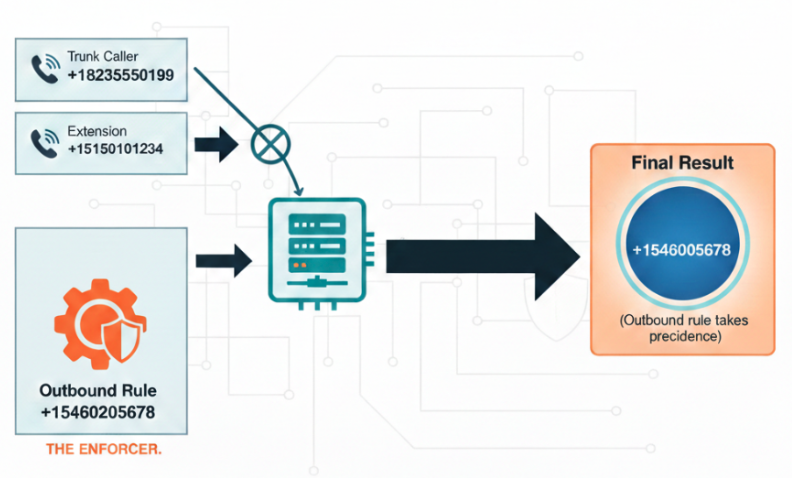
- Trunk Caller: +18235550199
- Outbound Rule: +15460205678
- Extension: +15150101234
- Result: +15460205678 (Outbound rule takes precedence)
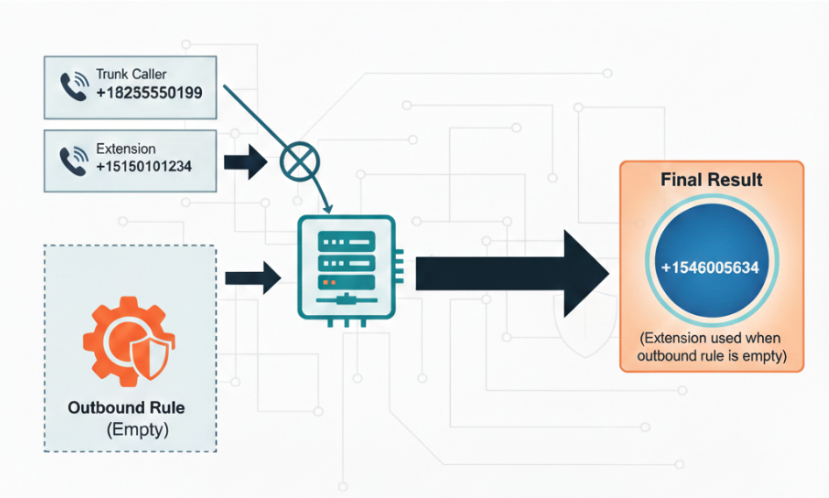
- Trunk Caller: +18235550199
- Outbound Rule: (Empty)
- Extension: +15150101234
- Result: +15150101234 (Extension used when outbound rule is empty)
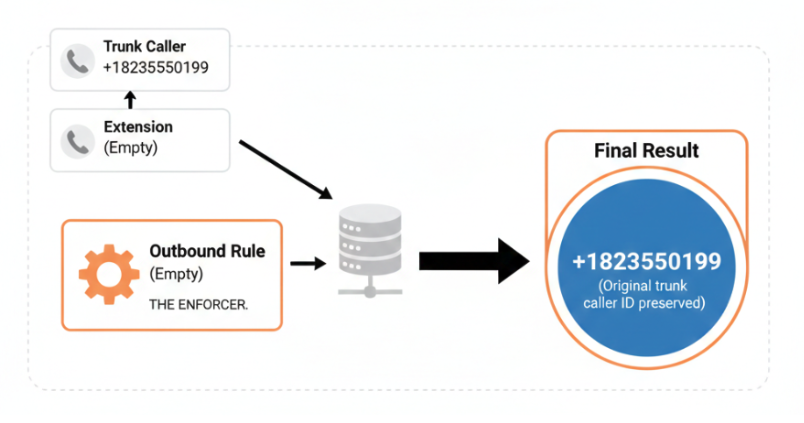
- Trunk Caller: +18235550199
- Outbound Rule: (Empty)
- Extension: (Empty)
- Result: +18235550199 (Original trunk caller ID preserved)
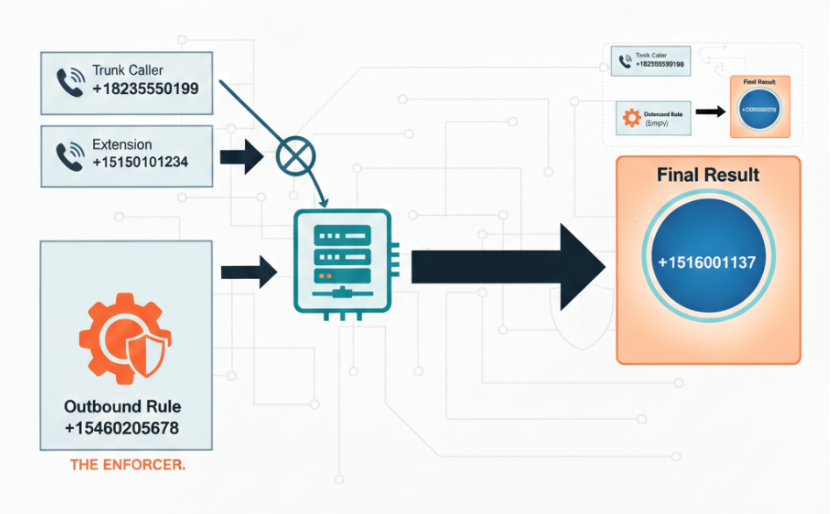
- Trunk Caller: (Empty)
- Outbound Rule: +15460205678
- Extension: (Empty)
- Result: +15460205678 (Outbound rule applied)
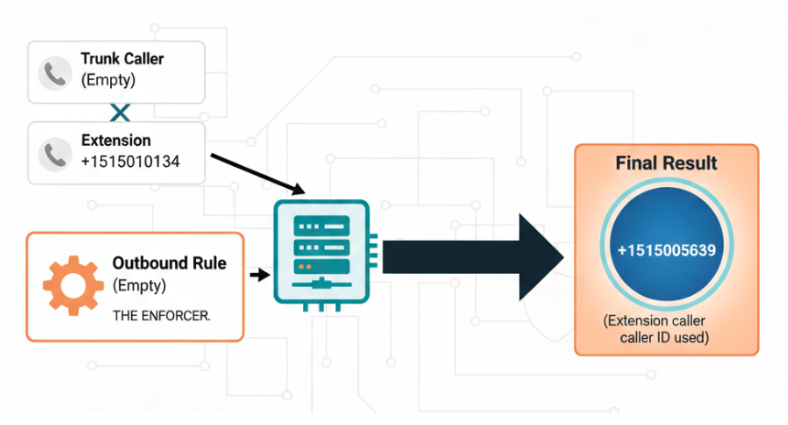
- Trunk Caller: (Empty)
- Outbound Rule: (Empty)
- Extension: +15150101234
- Result: +15150101234 (Extension caller ID used)
- Trunk Caller: +18235550199
- Outbound Rule: +15460205678
- Extension: (Empty)
- Result: +15460205678 (Outbound rule overrides trunk)
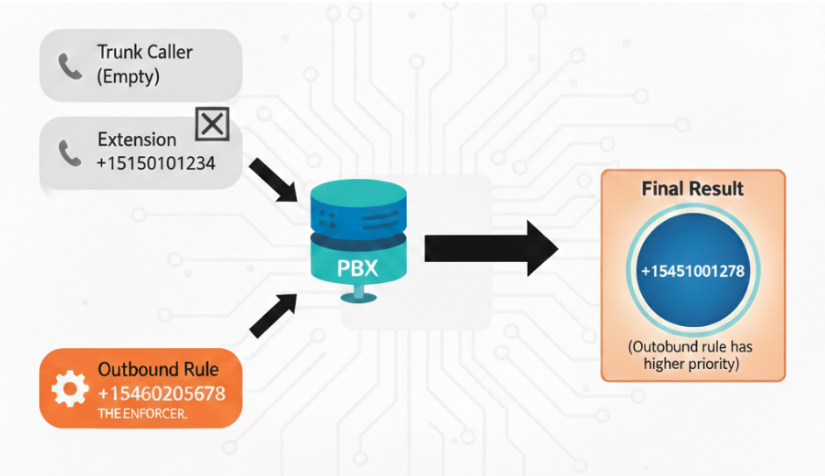
- Trunk Caller: (Empty)
- Outbound Rule: +15460205678
- Extension: +15150101234
- Result: +15460205678 (Outbound rule has higher priority)
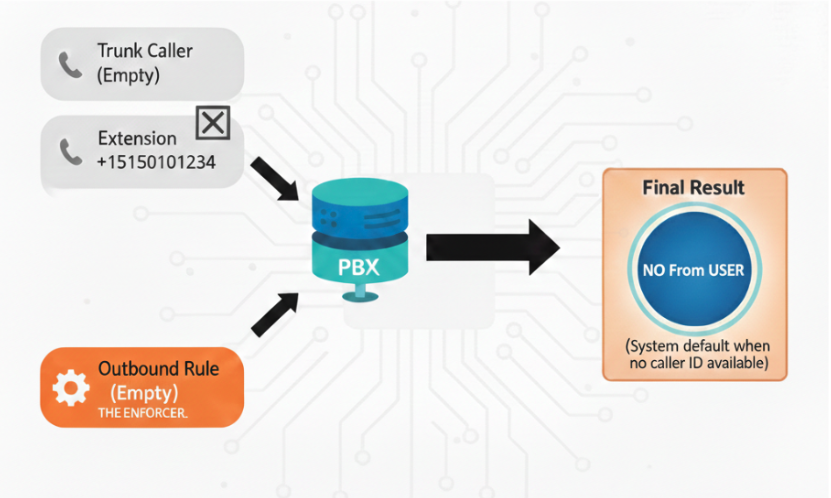
- Trunk Caller: (Empty)
- Outbound Rule: (Empty)
- Extension: (Empty)
- Result: NO From USER (System default when no caller ID available)
Scenario Analysis
| Scenario | Caller on Trunk (Priority 1) | Caller ID on Outbound Rule (Priority 2) | Caller ID on Extension (Priority 3) | Final Caller ID Reflected | Logic Applied |
|---|---|---|---|---|---|
| 1. Complete Override1 | +18235550199 | +15460205678 | +15150101234 | +15460205678 | Outbound Rule overrides Trunk and Extension |
| 2. Extension Override | +18235550199 | (Empty) | +15150101234 | +15150101234 | Extension used when Outbound Rule empty |
| 3. Trunk Passthrough | +18235550199 | (Empty) | (Empty) | +18235550199 | Original Trunk Caller ID preserved |
| 4. Outbound Rule Only | (Empty) | +15460205678 | (Empty) | +15460205678 | Outbound Rule applied when Trunk empty |
| 5. Extension Only | (Empty) | (Empty) | +15150101234 | +15150101234 | Extension Caller ID used as fallback |
| 6. Mixed Configuration | +18235550199 | +15460205678 | (Empty) | +15460205678 | Outbound Rule overrides Trunk |
| 7. Outbound with Extension | (Empty) | +15460205678 | +15150101234 | +15460205678 | Outbound Rule has higher priority than Extension |
| 8. No Caller ID Available | (Empty) | (Empty) | (Empty) | NO From USER | System default when no Caller ID configured |